AUTHOR: Ross Curtis, BV Capital President
what gives one property an advantage over another?
It is easy to understand the appeal of living near restaurants, retail, trails, and entertainment. It is harder to determine whether those features actually matter to the economics of a multifamily investment. Data shows that distinction is increasingly relevant in the Dallas-Fort Worth market.
DFW added more than 123,000 residents in the most recent year measured by the Census Bureau and grew roughly 11% between 2020 and 2025, the strongest population growth among major U.S. metros according to CBRE. At the same time, the region has seen an unusually large wave of new apartments. More than 37,000 multifamily units were delivered in both 2024 and 2025, compared with a prior five-year average of roughly 26,000 annually.
That creates an important question for investors: when residents have more choices, what gives one property an advantage over another?
Mixed-use development can be part of the answer. But simply placing apartments next to restaurants or a jogging trail does not create an investment thesis.
Demand matters. So does demand capture.
Multifamily investors typically spend a great deal of time reviewing population growth, household formation, employment trends, and competing supply. These measures gauge whether demand exists. They do not necessarily tell us which property captures it.
That distinction becomes particularly important in a supply-heavy market. DFW's stabilized multifamily occupancy stood at 92.3% in April 2026, while advertised asking rents were down 1.6% year over year through May, despite continued employment growth. Yardi Matrix
Population growth, in other words, does not automatically protect every apartment property from competition. Residents still have choices. A property's surrounding environment can therefore become part of its demand-capture strategy, giving residents reasons to choose the broader location rather than relying only on finishes, floorplans, pools, or fitness centers.
That distinction matters because competitors can replicate unit finishes and amenity packages relatively easily. They cannot as easily replicate an entire district.
Rendering of BV Development, The Alexander
Investor Lens
Market demand tells you how many renters may exist. Demand capture asks why they would choose this property.
The real advantage may be the replacement difficulty
One way to think about mixed-use development is through replacement difficulty.
A new competitor can build another Class A apartment community, offer similar unit finishes, and construct a clubhouse and resort-style pool. But duplicating an established ecosystem of restaurants, public space, trails, retail, entertainment, transportation, and residential density can require multiple parcels, operators, approvals, and years of development.
Jones Lang LaSalle's (JLL) 2026 research into what it calls Lifestyle Districts found rent and occupancy premiums across major property types. Importantly, JLL argues that the effect is not simply because those properties tend to be newer. Its research points instead to the interaction among uses and the ability of a district to keep residents, workers, and visitors spending time within the same ecosystem.
That is a more sophisticated way to evaluate “live, work, play.” The question is not simply whether there are restaurants nearby. It is whether another property could realistically recreate the same resident experience.
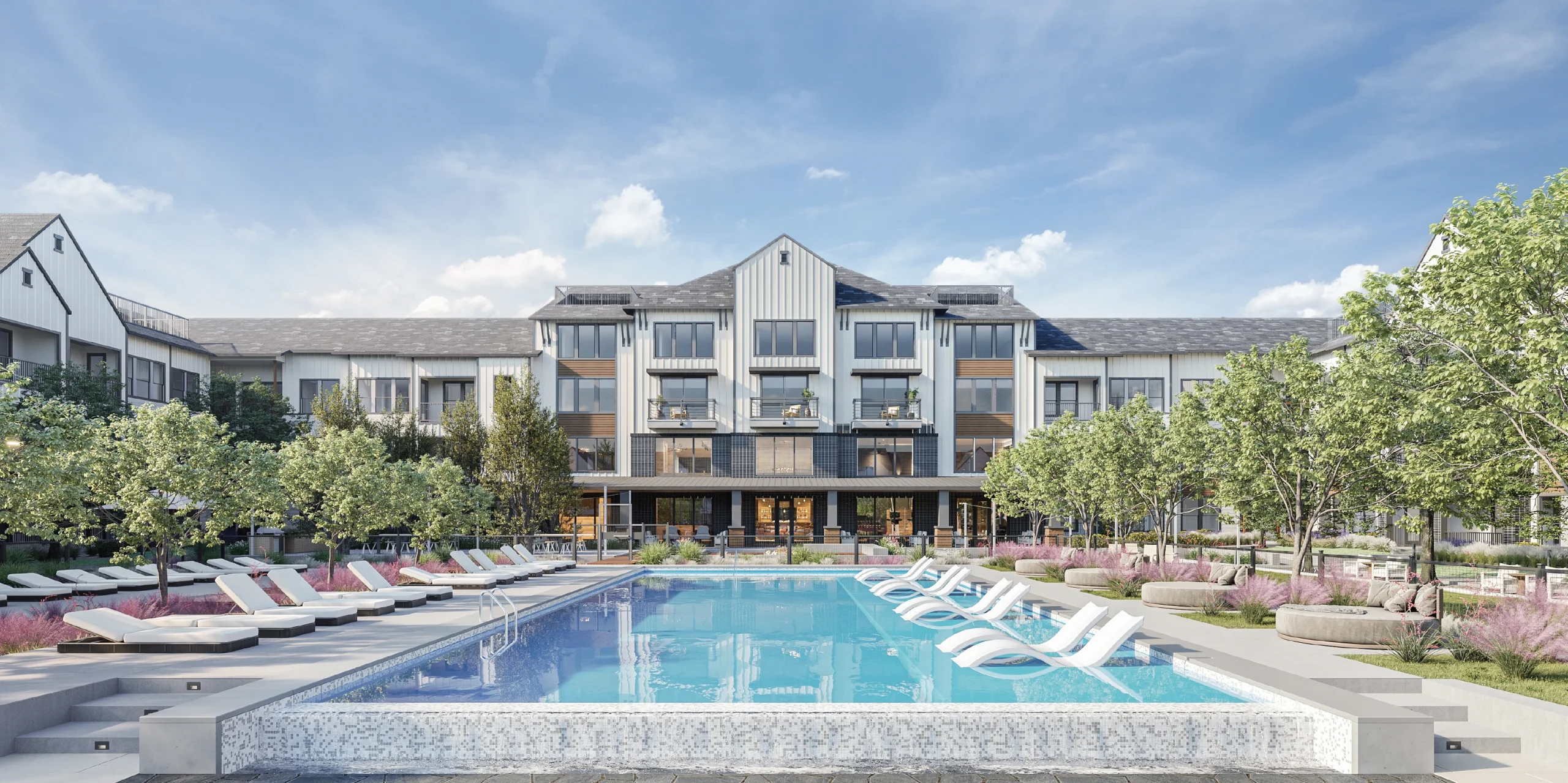
Rendering of BV Development, Landhaus at Gruene
Mixed-use can create a closed-loop economy
There is another concept worth paying attention to: capture rate.
JLL describes successful lifestyle districts as creating a “closed loop” in which residents and workers spend more of their leisure time within the surrounding district. Multifamily residents in these environments tend to keep more of their activity within the same node rather than leaving for unrelated destinations. JLL
For the residential component, that can matter in ways that are not immediately obvious. More activity can support retail. Better-performing retail can attract stronger tenants. Those tenants make the district more useful to residents, which can support residential demand. More residents, in turn, support the retail.
Done well, the different uses begin reinforcing one another. That is substantially different from an apartment building that simply happens to have a shopping center nearby. It is also why tenant mix matters. A district filled with businesses residents rarely use may technically be mixed-use while producing very little economic interaction between the pieces.
Timing risk may matter as much as location
Mixed-use development also introduces a risk sophisticated investors should pay particular attention to: sequencing.
A rendering can show apartments, restaurants, a hotel, and public space existing simultaneously, but reality develops on a calendar. If the residential component delivers first while surrounding commercial uses remain years away, the property may enter its most competitive lease-up period before the full location thesis exists.
That distinction matters because lease-up occurs in a market where concessions can be significant.
That makes the underwriting question more specific: which parts of the surrounding district will actually be complete when the property needs to attract its first 100, 200, or 300 residents?
That is a much more useful question than whether the master plan looks attractive.
The most interesting economic benefit may not even be what a resident is willing to pay on day one. It may be whether they want to leave later.
Renewal economics can matter more than the initial premium
Rendering of BV Development, Landhaus at Gruene
Turnover creates real friction for a multifamily owner through vacancy days, concessions, marketing, unit preparation, and leasing costs.
That is one reason the current renewal environment deserves attention. CBRE expects multifamily operators in 2026 to continue emphasizing occupancy over aggressive new-lease rent growth, particularly in high-supply Sun Belt markets. Nationally, 57% of leasing activity now comes from renewals, up from 51% in 2015 and 48% in 2005. CBRE also cites that renewal rent growth has been stronger than asking-rent growth on new leases.
That introduces another way of evaluating mixed-use. A resident can find another apartment with a comparable kitchen. Leaving the restaurants they frequent, the trail they use, their favorite coffee shop, and the area where they spend their weekends is a larger lifestyle decision. That does not mean mixed-use automatically produces higher retention. But it gives investors a more meaningful metric to monitor: does the surrounding environment increase resident stickiness?
Over time, renewal rates, renewal rent spreads, and turnover could tell a more important story than asking rent alone.
Rendering of BV Development, Landhaus at Gruene
The operating model matters, too
There is also an operational dimension that gets considerably less attention.
Where multiple pieces of a district are coordinated by the same ownership or management structure, there can be efficiencies beyond resident appeal. JLL estimates that single-owner lifestyle districts can reduce certain operating costs by as much as 10% compared with multi-owner districts, in part through shared services, coordinated amenities, and economies of scale. It also notes that shared district amenities can allow individual buildings to devote less space to duplicative amenities and potentially preserve more rentable area. JLL
That introduces a question investors might not normally ask when looking at an apartment deal: who controls the surrounding experience?
A multifamily property surrounded by independently owned parcels has less control over what happens around it. A coordinated district may have greater ability to influence tenant mix, programming, public space, and maintenance. The address can look similar while the control structure is very different.
What does DEMAND look like in North Texas?
Rowlett Station offers one useful example of a different version of this concept.
The property sits directly adjacent to the Downtown Rowlett DART Blue Line station, providing direct rail access toward Dallas. When financing for the property was announced in 2026, the 92%-occupied asset had in-place rents below comparable properties in its submarket, according to Cushman & Wakefield.
Its distinguishing feature is not simply an amenity package inside the property. Transit itself becomes part of the location's utility. That illustrates the broader principle: different developments can create location value in different ways. For one property, it may be rail access. For another, employment, retail and entertainment, trails, public space, or the concentration of multiple uses within walking distance.
The investor's job is to determine whether that utility is both real and difficult to replace that can serve as a barrier to entry.
Applying the demand criteria to Parkway Lofts
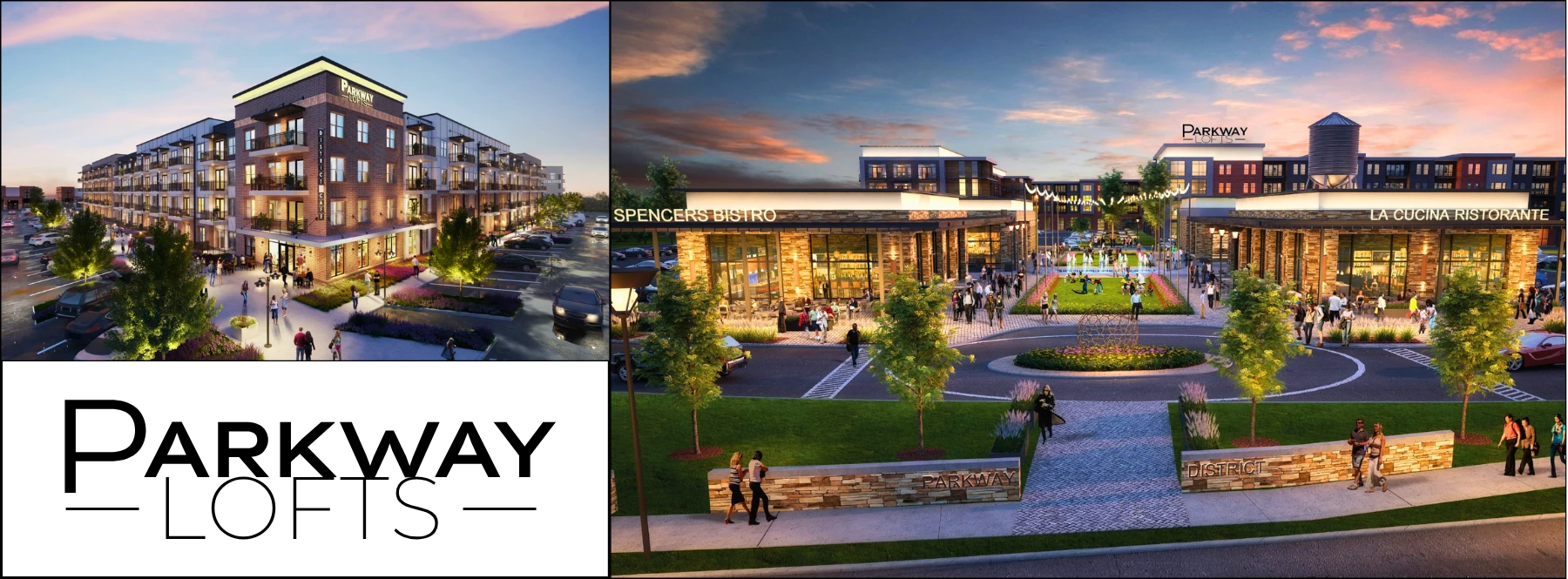
Renderings of Parkway District and Parkway Lofts
That brings the discussion closer to Parkway Lofts in Corinth.
The larger Parkway District has been planned as more than a standalone residential project. Parkway Lofts itself is a Class A multifamily community, while the surrounding Parkway District is expected to include restaurants, retail, activated green space, trails, and future hospitality. City materials describe the broader district as a walkable mixed-use development intended to connect residential, commercial, and public-space uses. City of Corinth Texas
The surrounding context is continuing to develop as well. Agora Park opened in 2024 and is already serving as a community gathering area. The city also lists a separate City Center project planned with 30,000 square feet of ground-floor retail and 300 residential homes, alongside additional residential development in Downtown Corinth. City of Corinth Texas
That starts to make the Parkway discussion more interesting than simply saying there will be apartments near restaurants. The more substantive questions become:
- How much residential density is forming around this node?
- Which commercial and public-space components will actually exist during Parkway's lease-up?
- Does the combination of I-35E access, Agora Park, trails, and planned commercial uses create enough utility to distinguish Parkway from other Class A supply?
- And as the district matures, does that environment become harder for a competing apartment property to replicate?
Those are ultimately questions of absorption, differentiation, and durability.
What investors should look beyond
The phrase: live, work, play has been used so often in real estate that it can easily become meaningless.
For investors, the useful analysis starts one level deeper. A mixed-use environment matters when its pieces reinforce one another strongly enough to influence demand, improve competitive positioning, support retention, or create operating efficiencies. Those benefits depend on more than just a rendering. They depend on what gets built, when it gets built, how the pieces interact, and whether residents actually use them.
That is the difference between having amenities nearby and having a location that becomes part of the investment thesis.